


























Views
Downloads
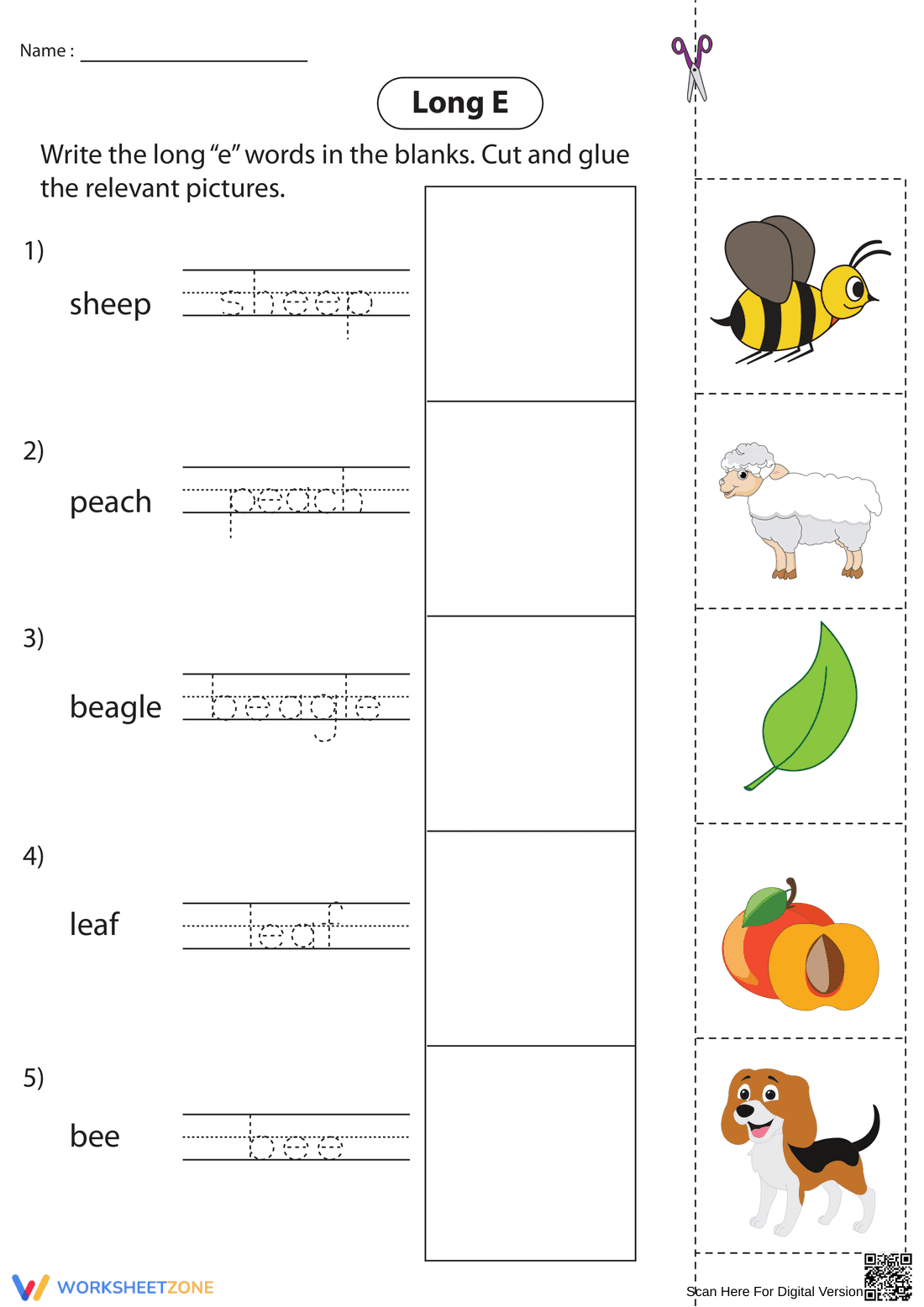

Grade 1-2 Long E — Printable No-Prep Worksheet
Paste this activity's link or code into your existing LMS (Google Classroom, Canvas, Teams, Schoology, Moodle, etc.).
Students can open and work on the activity right away, with no student login required.
You'll still be able to track student progress and results from your teacher account.
This Grade 1-2 Long E words worksheet provides students with a hands-on opportunity to master common vowel teams and spelling patterns. By combining tracing, writing, and tactile cut-and-glue activities, learners reinforce their phonemic awareness and grapheme-to-phoneme mapping. This resource is designed to build confidence in decoding and encoding essential long vowel sounds.
At a Glance
- Grade: 1-2 · Subject: English Language Arts
- Standard:
CCSS.ELA-LITERACY.RF.1.3.C— Know common vowel team conventions for representing long vowel sounds- Skill Focus: Long E Vowel Teams (ee, ea)
- Format: 1 page · 5 problems · Cut and glue activity · PDF
- Best For: Literacy centers and independent phonics practice
- Time: 15–20 minutes
This high-quality phonics resource features a single-page layout focused on five essential long "e" words: sheep, peach, beagle, leaf, and bee. Each task includes a tracing component to support fine motor development and spelling accuracy, followed by a blank gluing zone. The worksheet includes a dedicated sidebar with five vibrant illustrations designed for easy cutting, ensuring students can visually associate sounds with their corresponding objects.
Zero-Prep Workflow
- Print: Generate the single-page PDF for your group in under 30 seconds.
- Distribute: Hand out pages with scissors and glue; students can begin immediately with zero additional teacher modeling or complex instructions (1 minute).
- Review: Quickly check completed work using the clear visual layout to verify phonics mastery in less than two minutes.
Total teacher preparation time is minimized, making this an ideal choice for morning work, literacy stations, or emergency sub plans.
Standards Alignment
The worksheet is strictly aligned with CCSS.ELA-LITERACY.RF.1.3.C, which requires students to know final -e and common vowel team conventions for representing long vowel sounds. By practicing with words like "sheep" (ee) and "leaf" (ea), students demonstrate their ability to distinguish and encode varied vowel patterns. This standard code can be copied directly into lesson plans, IEP goals, or district curriculum mapping tools.
How to Use It
Use this worksheet as a formative assessment after a direct instruction lesson on long vowel sounds to gauge individual student progress. It works exceptionally well in a literacy center where students can work independently or in pairs to discuss the different "ee" and "ea" spelling patterns they observe. For a quick check, walk around during the cutting phase to observe if students are correctly identifying images before they apply glue.
Who It's For
This resource is tailored for first and second-grade students who are transitioning from basic CVC words to more complex vowel teams. It provides necessary scaffolding for ELL students through visual aids and tracing guides, while still offering enough rigor for general education learners. It pairs naturally with a long vowel anchor chart or a reading passage focused on nature themes to provide a comprehensive literacy experience.
Phonemic mastery and the ability to decode complex vowel teams are foundational pillars of early literacy development, as highlighted in the RAND AIRS 2024 report on foundational reading skills. This worksheet targets CCSS.ELA-LITERACY.RF.1.3.C by requiring students to actively engage with the long "e" sound through multi-sensory interactions. Research from Fisher & Frey (2014) emphasizes that combining fine motor tasks like cutting and gluing with linguistic exercises such as tracing and spelling significantly improves retention and word recognition in primary learners. By isolating the long "e" sound across five distinct tasks, this resource ensures that students move beyond rote memorization toward a deeper structural understanding of English orthography. Educators can utilize these specific metrics and task counts to justify curriculum choices during parent-teacher conferences or administrative evaluations, ensuring that every minute of classroom time contributes directly to measurable standards-based achievement.


